
Automatic rewards teach kids to cut corners, while parent approval fosters clear communication, shared family responsibilities, and a genuine sense of accomplishment.
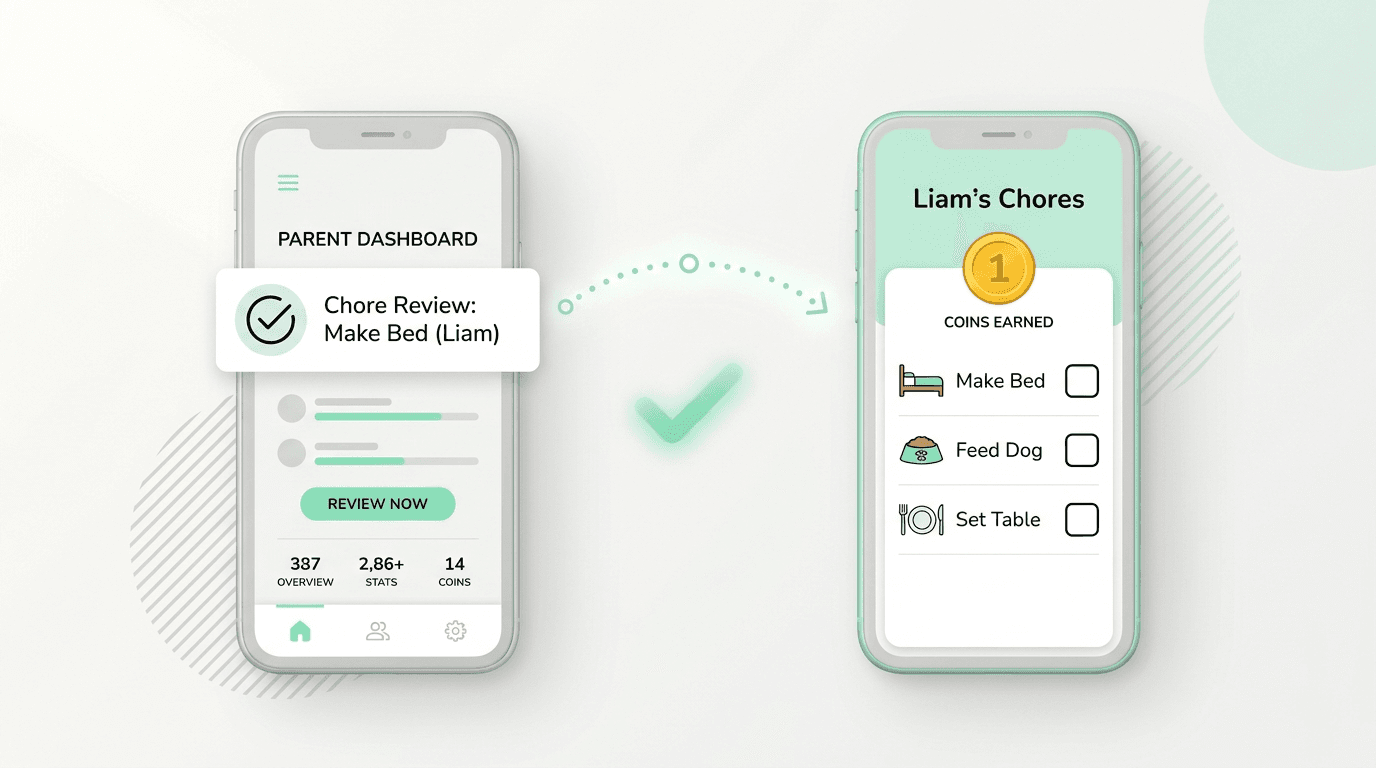
When setting up a new routine, it can be tempting to automate everything. After all, automation saves time. But when it comes to teaching responsibility, automatic rewards can accidentally teach the wrong lesson. If a child marks a chore as “done” and instantly receives a reward, the focus shifts from the quality of the work to simply checking a box.
This is why a parent approval chore app is fundamentally more effective than a fully automated system. By keeping a parent in the loop as the final reviewer, you transform a simple task list into a meaningful learning opportunity about shared family responsibilities, clear expectations, and fair compensation.
Clear ownership and what “done” actually means
One of the most common household friction points is the mismatch between a child’s definition of “done” and a parent’s. To a child, tossing clothes into a hamper might equal a clean room. To a parent, “done” means the clothes are in the hamper, the floor is clear, and the bed is made.
A parent approval workflow bridges this gap. When a child submits a chore, it enters a review queue. This pause creates a natural moment for alignment. If the task meets the agreed-upon standard, the parent approves it, and virtual coins are awarded. If it falls short, the parent can gently send it back with a specific, constructive note (e.g., “Great start! Please remember to put the shoes in the closet, too.”). This teaches children that clear ownership means seeing a task through to its actual completion, not just starting it.
Rotating chores fairly and shared family responsibilities
A healthy household runs on shared family responsibilities, not a rigid, permanent division of labor. Rotating chores fairly ensures that no single child feels targeted with the least desirable tasks, and it helps kids develop a well-rounded skill set.
When a parent manages the chore assignments and approvals, they can easily adjust the workload week by week. You might notice your 10-year-old is handling the dishwasher with ease, so you rotate them to vacuuming, while your 7-year-old takes over the dishwasher. Because the parent controls the dashboard, the system remains flexible and fair, adapting to the family’s changing schedule rather than locking everyone into a static, impersonal routine.
Handling complaints and keeping approval decisions consistent
Inevitably, there will be moments when a child disagrees with a decision. “But I did it!” is a common refrain. This is where consistency becomes your greatest tool.
When approval is manual, you have the opportunity to explain your reasoning calmly and specifically. Refer back to the original chore description. If you require optional photo proof for certain tasks, the photo serves as a neutral, objective reference point for both of you to look at together. Over time, this consistency builds trust. Children learn that the rules are predictable, and that their effort, when applied correctly, will reliably be recognized and rewarded.
How KidMint makes parent approval simple
Managing this workflow shouldn’t add stress to your day. KidMint is designed as a practical parent approval chore app that keeps the process calm and straightforward for families with children ages 5 to 18.
Here is how it supports your family’s routine:
Two Sides, One Family
Parents get a calm dashboard to set chores, assign coin values, and review submissions. Kids get an age-appropriate interface (Sprout, Explorer, or Pro) to view their tasks and request rewards.
Optional Photo Proof
For tasks where clarity matters, kids can snap a quick photo. This is strictly a private review aid for you, not a public feed or AI-graded assignment.
Virtual Coins, Real Lessons
Kids earn virtual coins only after you approve the work. These coins have no cash value and KidMint is not a bank or debit card; they are family points that kids can save up to request rewards you have pre-approved in the family store (like extra screen time, a favorite dessert, or a family outing).
No Complex Logins for Kids
Children join the family using a simple family code and a 4-digit PIN. They do not need their own email address or Google account.
If you are looking for ways to further motivate kids to do chores, pairing this approval workflow with a well-stocked, meaningful reward store is key. You can learn more about structuring this in our guide to building a family reward system, or read our article on how to motivate kids to do chores for additional practical strategies.
Conclusion
Automatic rewards might seem convenient, but they bypass the most valuable part of the chore process: the connection and communication between parent and child. By choosing a parent approval chore app, you are not just tracking tasks; you are teaching your children what it means to do a job well, handle feedback gracefully, and earn rewards through genuine effort.
Ready to set up a system that works for your household? You can set up your family in KidMint in under five minutes.
Questions parents ask
What happens if my child disagrees with my approval decision?
Use it as a calm teaching moment. Refer back to the original chore description or the optional photo proof. Explain specifically what needs to be adjusted. Consistency in your feedback helps children understand expectations and builds trust over time.
Do kids need their own email or Google account to use a parent approval chore app like KidMint?
No. In KidMint, children join the family workspace using a unique family join code and a 4-digit PIN set by the parent. This keeps their experience safe, simple, and free of unnecessary account setups.
Are the coins kids earn in KidMint real money?
No. KidMint coins are virtual family points. They have no cash value, and KidMint is not a bank, wallet, or debit card. Parents define what the coins are worth in their own home by stocking the reward store with treats, privileges, or real-world allowances that the parent fulfills directly.